
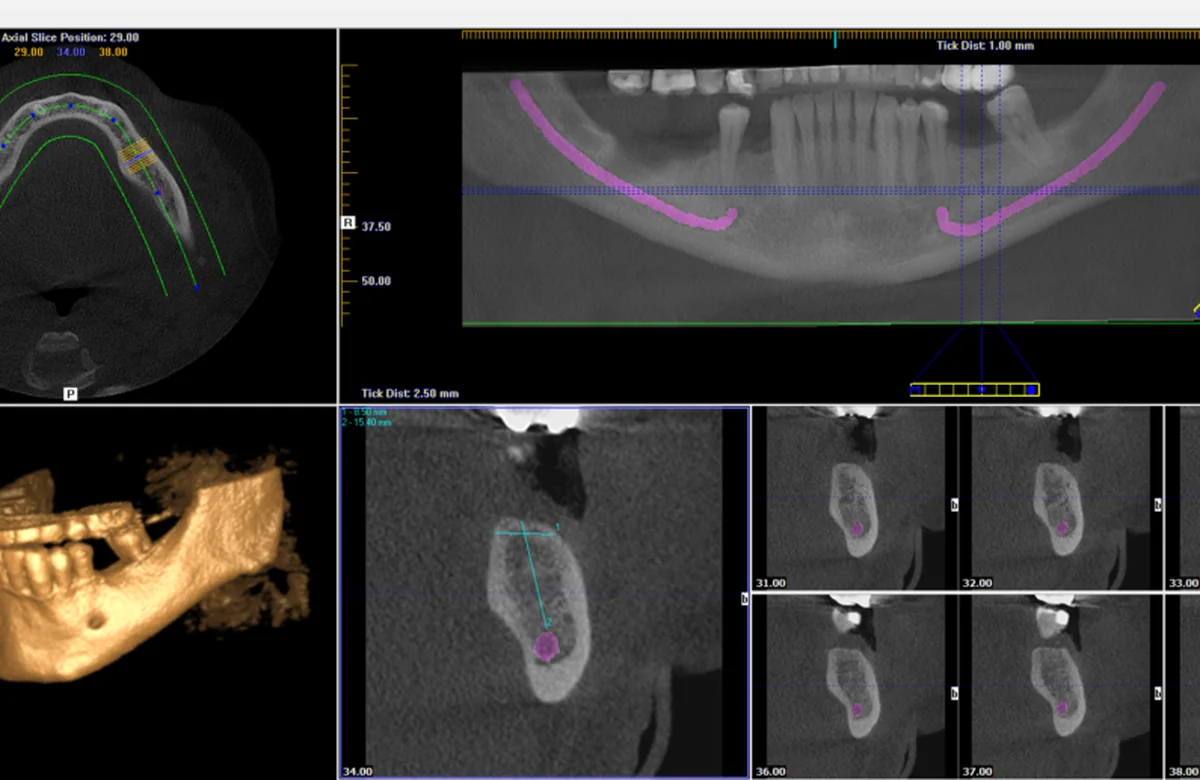
CBCT scans are essential tools in guiding oral surgery and implant placement, providing your clinician with highly detailed images used to meticulously plan your treatment. This is particularly advantageous for implant placement, as cone beam CT scans enable the precise positioning of implants in the jawbone while carefully avoiding nerve tissue and sinuses.
This precision not only minimises recovery time but also reduces discomfort and accelerates healing. Additionally, CBCT scans significantly mitigate the risk of nerve injury — especially when operating in proximity to the delicate nerves in the lower molar area, blood vessels, and the sinuses above the upper molars.
Another advantage of using cone beam CT scans is the reduced time under anaesthesia. With comprehensive imaging that reveals the entire craniofacial structure, your dentist can perform procedures more efficiently, streamlining the process and enhancing overall safety.
In short, a CBCT scan lets us
- See bone height, width and quality in three dimensions before any surgery
- Place implants precisely while avoiding nerves, blood vessels and sinuses
- Plan surgical guides for accurate, minimally invasive placement
- Reduce time in the chair, discomfort and healing time